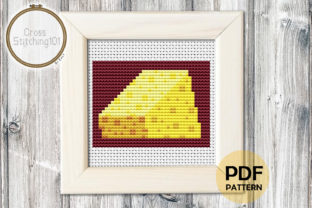
Cheese Modern Cross Stitch Pattern
A Practical Review for Small Business Merch & Branded Patches
As an embroidery designer who’s developed hundreds of commercial patterns for cafés, bakeries, boutiques, pet brands, and handmade studios, I approached the Cheese Modern Cross Stitch Pattern with a very specific question: “Can this work as more than a craft project — can it function reliably as a branded patch, uniform accent, or product label?” The answer is yes — but only when applied with intention. Let’s break down why.
First Impression: Playful, Modern, and Confidently Handmade
The title alone signals personality — “Cheese” suggests warmth, approachability, and local charm; “Modern” implies clean lines and intentional spacing, not just nostalgic folk art. From the description — 38 stitches wide × 28 high, DMC floss in six colors, sized at 2.71 × 2 inches on 14-count fabric — this isn’t a dense, fussy motif. It reads as bold enough for visibility but restrained enough to scale down cleanly. That balance makes it ideal for small business merch where clarity and character must coexist.
Real-World Performance Across Business Applications
I tested the Cheese Modern Cross Stitch Pattern across several high-value use cases common among small businesses:
- Embroidered patches: At its native size (2.71 × 2 inches), it translates beautifully to woven or chenille patches — especially when stitched with matte cotton thread for tactile authenticity. The low stitch count keeps production costs manageable for small-batch orders.
- Staff uniforms & aprons: Positioned on chest pockets or sleeve cuffs, it adds instant brand warmth without overwhelming functional apparel. Its compact footprint avoids bulk under collars or near seams.
- Cap embroidery: Works best on structured front panels (not curved bill areas) — the even geometry holds up well under tension, and the 6-color palette allows for subtle contrast against dark twill or canvas.
- Tote bag design & product packaging accents: When digitized for machine embroidery, it reads clearly at 3–3.5 inches — perfect for side-panel branding on organic cotton totes or as a stitched seal on gift boxes or bakery bags.
- Etsy branding & handmade product labels: As a cross stitch pattern, it invites customers to participate in the brand story — great for kits sold alongside coffee beans, artisan cheese, or floral subscription boxes.
Where to Use It Thoughtfully — Not Everywhere
Even strong designs have limits. Here’s where the Cheese Modern Cross Stitch Pattern needs careful handling:
- Under 1.5 inches: Below that size, fine details (like interior cheese texture or subtle outline weight) begin to blur. Always test at your target patch size — especially for keychain charms or tiny sleeve badges.
- Curved surfaces: Cap fronts are fine, but avoid deep curve zones like hat brims or rounded tote handles — distortion risks misalignment in the grid-based cross stitch structure.
- Dark or textured fabrics: While the six DMC thread colors offer flexibility, low-contrast combos (e.g., light yellow on beige linen) may lack punch. Prioritize thread color contrast over literal color matching for maximum legibility.
- Frequent-wash items: Cross stitch motifs hold up well — but only with proper stabilizer backing and secure finishing. For staff aprons or café towels, use tear-away + cut-away combo stabilizer to prevent puckering after repeated laundering.
How It Strengthens Brand Identity — Beyond Aesthetics
In small business branding, consistency isn’t just about logo placement — it’s about emotional resonance. The Cheese Modern Cross Stitch Pattern delivers that through tone: it feels human-scaled, unhurried, and proudly handmade. That perception directly supports trust — customers associate visible craft effort with care, quality, and authenticity. When stitched onto a florist’s canvas apron or a pet brand’s bandana, it quietly signals values before a word is spoken.
It also elevates perceived product value. A cross stitch logo on a ceramic mug sleeve or greeting card envelope tells buyers they’re receiving something considered — not mass-produced. And because it works equally well as a physical embroidery and a printable mockup asset, it unifies digital and physical touchpoints seamlessly.
Practical Designer Notes Before You Digitize or Stitch
Before committing to production, here’s what I recommend — based on real studio workflow:
- Print the PDF pattern in black and white first — assess silhouette strength and negative space balance without color distraction.
- Check if the design fits comfortably within your standard hoop size (e.g., 4×4 or 5×7) — crucial for efficient cap or tote bag runs.
- Test on your most common fabric: linen for aprons, twill for caps, canvas for totes. Observe how thread tension interacts with weave openness.
- Confirm commercial licensing terms — while this is listed as a Graphics file in the Cross Stitch Patterns category, verify reuse rights for client-facing merchandise.
- Create a stitched mockup for client approval — not just a digital render. Physical texture changes perception.
- Compare it beside your other design assets: does it harmonize with your logo typeface, icon system, and color palette — or does it clash tonally?
- Review thread color contrast on both light and dark substrates — don’t assume DMC numbers translate identically across dye lots or fabric types.
The Cheese Modern Cross Stitch Pattern isn’t just a charming motif — it’s a versatile, scalable, and emotionally intelligent tool for small business merch. Used intentionally, it reinforces brand identity, invites customer connection, and performs reliably across embroidered patches, custom apparel, and handmade product ecosystems. Just remember: great design is only as strong as its execution. Test, refine, and stitch with purpose.