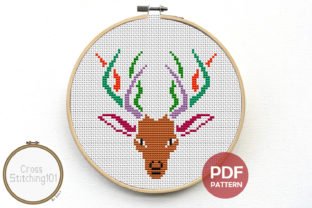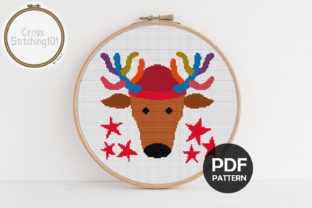
Deer Head Pattern Modern Cross Stitch
A Craft Fair Designer’s First Look: Bold, Minimal, and Instantly Recognizable
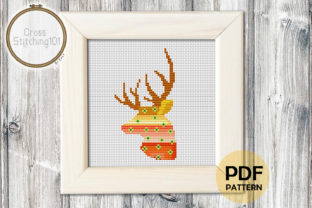
As an embroidery designer who’s packed 147 craft fair booths over the past decade, my first impression of Deer Head Pattern Modern Cross Stitch is immediate: it’s clean, confident, and quietly commanding. The title alone signals intention—“Modern” isn’t just a buzzword here; it’s baked into the geometry of that head silhouette, the balanced negative space, and the restrained 36 × 65 stitch count. This isn’t a fussy woodland scene or a nostalgic vintage motif—it’s a distilled, graphic deer head with contemporary edge. It reads as minimalist at a glance but rewards closer inspection with subtle texture in the antlers and expressive line weight. For handmade market sellers, that duality is gold: it attracts both the “I want something unique but not weird” shopper and the design-savvy buyer scanning for quiet sophistication.
Where It Shines on Craft Fair Products
Tote bags and market bags: At 2.57 inches wide, Deer Head Pattern Modern Cross Stitch lands perfectly centered on the lower corner of a natural canvas tote—small enough to feel intentional, large enough to read from three feet away. It adds artisanal weight without overwhelming. On darker fabrics (navy, charcoal, olive), the DMC 22-color palette gives rich contrast—especially if you emphasize mid-tone browns and cream highlights.
Aprons and tea towels: This pattern excels as a top-left chest accent on denim or linen aprons. Its vertical orientation (65H) mirrors the natural flow of an apron bib, making it feel custom-fit—not pasted on. On tea towels, place it just above the hem: it reads as decorative *and* functional, like a signature stamp for your kitchen brand.
Patches and pouches: With its tight stitch count and clear outline, Deer Head Pattern Modern Cross Stitch translates beautifully to embroidered patches—ideal for pinning onto jackets or stitching onto drawstring pouches. The compact size means low thread consumption and fast turnaround for batch production.
Pillow covers and caps: Here’s where attention to detail matters. On curved cap surfaces, test placement early—the narrow height (2.57”) avoids distortion across the front panel. For pillow covers, use it as a single focal point on a solid linen or oatmeal base. It reads as premium, not crafty.
What Makes It Sell—And What Requires Care
This pattern sells because it’s instantly legible, emotionally neutral (neither overly cute nor stern), and scales reliably across product types. Customers notice it fast in a crowded booth—its shape cuts through visual noise. Online, it photographs cleanly: no fine gradients or bleeding edges to muddy Etsy thumbnails or printable mockups.
But practicality demands caution:
- Stitch density: At 36 × 65, it’s light—but check the PDF for clusters. Dense antler tips or eye details may require stabilizer on textured towels or thick denim.
- Fabric texture: Avoid highly napped or ribbed fabrics (like terry cloth or heavy bouclé) unless you pre-test. The clean lines blur easily.
- Dark fabric contrast: With 22 DMC colors, you’ve got flexibility—but verify thread brightness against your base fabric. A soft taupe thread on black linen can vanish. Prioritize high-contrast neutrals (ecru, charcoal, rust) for booth visibility.
- Small size limitations: Below 2 inches wide, antler tips and inner ear definition soften. Skip using it smaller than 2.25” on patches or keychains.
Design Notes Every Embroidery Seller Should Follow
Before cutting fabric or listing on Etsy, do this:
- Test on scrap fabric identical to your final product—same weave, weight, and dye lot.
- Check thread contrast under booth lighting (not just daylight). Bring a portable LED lamp to your test setup.
- Review spacing and alignment—especially if pairing with text (e.g., “Wild & Made” beneath the deer). Does the negative space breathe?
- Confirm hoop size compatibility. At ~2.6”, it fits most 4-inch hoops comfortably—but verify before digitizing for machine embroidery.
- Inspect stitch density zones. If the PDF shows tight clusters in the antlers or jawline, add lightweight tear-away stabilizer.
- Create at least one real mockup—not digital. Hang it beside your other bestsellers. Does it hold its own? Does it look handmade, not mass-produced?
- Compare fabric colors. A cream deer on oatmeal linen reads warm and cohesive; on heather gray, it can feel washed out.
- Confirm commercial licensing. Since this is a Cross Stitch Patterns digital download, review terms before selling finished products—especially for wholesale or boutique distribution.
Why It Strengthens Your Booth—and Your Brand
Deer Head Pattern Modern Cross Stitch doesn’t shout. It invites. That makes it unusually effective in person: shoppers slow down, tilt their heads, and ask, “Is that hand-stitched?” That question is your opening to talk about materials, process, and story. It elevates perceived value—especially when stitched on heavyweight linen or organic cotton. For Etsy sellers, it’s a strong anchor for a cohesive collection: pair it with matching botanical motifs or neutral-toned thread kits. For small shop owners, it reinforces brand consistency—clean, nature-adjacent, unhurried. And for craft fair sellers? It’s booth glue: a recognizable motif that customers remember and seek out year after year.
In short: this isn’t just another Graphics file. It’s a versatile, scalable, customer-ready asset—if you treat it with the attention a handmade product deserves. Test. Refine. Repeat. Then watch it become your quiet bestseller.