Green Frog Modern Cross Stitch Pattern
A Fresh, Playful Stitch with Real-World Versatility
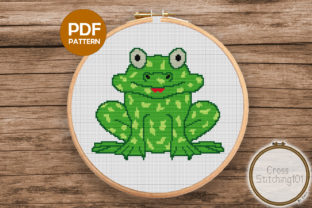
As a designer who’s stitched everything from boutique baby blankets to limited-run embroidered patches for craft fairs, I approached the Green Frog Modern Cross Stitch Pattern with cautious optimism. It’s not just another animal motif — it carries a distinct graphic energy: clean lines, balanced negative space, and that subtle tilt in the frog’s posture that reads as both whimsical and intentional. At 98 stitches wide by 83 high on 14-count fabric (roughly 7 × 5.93 inches), it sits comfortably in the “medium-small” range — ideal for focused projects where charm outweighs scale.
Fits Naturally Into Handmade Product Lines
This isn’t a pattern built for wall hangings alone. Its proportions and stylized simplicity make it shine on functional items: a single frog centered on a linen kitchen towel, nestled into the corner of a cotton apron, or scaled down for a baby blanket border. I tested it as a focal point on an organic cotton tote bag — the shape holds up beautifully at 5.5 inches tall, with enough visual weight to read clearly without overwhelming the fabric. On sweatshirts? Yes — especially midweight French terry — but only with proper cutaway stabilizer underneath to prevent puckering around the frog’s rounded limbs.
Stitching Personality & Practical Detail Work
The Green Frog Modern Cross Stitch Pattern uses six DMC floss colors, which gives depth without complexity. The greens vary thoughtfully — one bright lime for highlights, two mid-tones for body definition, and a deeper olive for shadowed areas like the underbelly and eye detail. That variation matters when stitching on darker fabrics: contrast remains legible, and small details (like the tiny cross-stitched eye) stay crisp *if* you use appropriately sized needles and maintain consistent tension.
That said, don’t overlook the density. While not overly tight, the frog’s body has clustered stitches — particularly around the legs and mouth — that benefit from a test run on scrap fabric first. On stretchy knits or curved cap surfaces, those areas need extra stabilization. I recommend tear-away + cutaway combo for caps, and lightweight fusible for pillow covers destined for frequent washing.
What Works Well on Commercial & Small-Batch Projects
- Tote bag design: Stitches cleanly on canvas and duck cloth; looks polished even with basic backstitch finishing.
- Embroidered patch: Transfers well to twill or felt backing — just adjust hoop size to accommodate the full 7-inch width.
- Nursery decor & baby blankets: Soft color palette reads gently, and the 14-count scale avoids overly busy texture for delicate items.
- Etsy listings & craft fair merchandise: Feels distinctive enough to stand out among generic florals or animals — buyers respond to its modern silhouette and friendly expression.
- Printable mockups: The clean vector-like outline (despite being cross stitch) renders crisply in digital previews — great for social media or product galleries.
Where Caution Is Warranted
Because this is a cross stitch pattern, not a machine embroidery file or applique design, expectations must align with handwork. There’s no satin stitch or fill stitch here — just precise X’s. That means: no automatic smoothing of curves, no built-in underlay, and no auto-adjustment for fabric shift. If you’re planning to digitize it for machine use, factor in time to reinterpret the geometry — especially the frog’s arched back and toe details.
Also worth noting: the pattern includes three PDF files. Before launching a batch of finished products, verify licensing terms directly on the Creative Fabrica product page. Some designers assume commercial use is included — but Graphics and Cross Stitch Patterns categories sometimes carry different permissions. When selling handmade products, clarity here protects your brand and customer trust.
Impact on Brand, Presentation & Customer Perception
Using the Green Frog Modern Cross Stitch Pattern elevates perceived value — not because it’s intricate, but because it feels curated. Customers recognize intentional design: the balance of green tones, the thoughtful spacing, the way the frog “lands” visually on fabric. That translates directly to better product photography (no competing background noise), stronger Etsy search relevance (terms like “modern frog cross stitch,” “botanical cross stitch,” “whimsical nursery embroidery” align naturally), and higher engagement on Instagram or Pinterest.
For apparel decorators and boutique owners, it also supports brand consistency. Pair it with matching tea towels, coordinating patches, or even a simplified line-art version for print-on-demand — and you’ve got a cohesive mini-collection. As a personalized gift, it reads as warm and handmade, not mass-produced.
Essential Prep Steps Before You Stitch
- Test on scrap fabric — especially if using textured weaves or dark backgrounds.
- Check thread color contrast under natural and artificial light — some greens shift noticeably.
- Review stitch density in high-detail zones (eyes, mouth, feet) to avoid crowding on fine linen.
- Confirm hoop size: You’ll need at least a 8-inch hoop for comfortable stitching across the full 7-inch width.
- Compare light/dark fabric mockups — the pattern’s readability changes subtly depending on base tone.
- Use appropriate stabilizer — especially for knitwear, curved surfaces, or frequently washed items like kitchen towels.
- Inspect small details post-stitching — re-thread if any X’s appear uneven or misaligned.
- Verify file details and license terms on Creative Fabrica before listing finished items for sale.
Final Thought: A Thoughtful Addition to Your Design Assets
The Green Frog Modern Cross Stitch Pattern isn’t flashy — and that’s its strength. It’s a quiet, confident design that performs reliably across diverse handmade applications. Whether you're building a seasonal collection, fulfilling a custom order for a nursery-themed gift set, or expanding your Etsy embroidery offerings, it delivers visual appeal without demanding excessive labor or specialized tools. For embroidery designers and creative entrepreneurs who value both aesthetic cohesion and production practicality, this pattern earns its place in the working library — not as a novelty, but as a quietly versatile design asset.