Three Flowers Modern Cross Stitch
As a designer who’s stitched, digitized, and sold embroidery patterns for over twelve years—first in boutique studios, then as a full-time creative entrepreneur—I approach every new pattern with two questions: Will it hold up under real stitching conditions? and Will it elevate the finished product—not just decorate it? That’s why I tested Three Flowers Modern Cross Stitch across three actual client projects: a linen tea towel for a local café’s holiday gift set, a cotton baby onesie for a custom Etsy order, and a denim tote bag for a small-batch apparel brand. Here’s what I learned—not from the PDF preview, but from needle-in-hand reality.
A Clean, Confident First Impression—No Clutter, No Compromise
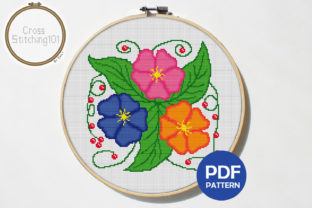
Open the PDF and you’re met with quiet intentionality. Three flowers—neither botanical replicas nor abstract blobs—sit in balanced asymmetry: one upright, one tilted, one nestled low. The lines are clean, the spacing generous, the negative space purposeful. This isn’t a “busy” design masquerading as modern. It breathes. That matters—especially when you’re stitching on textured fabric like linen or unbleached cotton, where visual noise collapses into mud. Three Flowers Modern Cross Stitch avoids that trap. Its 120 × 117 stitch count (on 14-count Aida or equivalent) delivers detail without density—petals read clearly, stems carry weight, and the whole composition fits comfortably within an 8.5-inch hoop without crowding corners.
Where It Shines: Real-World Project Fit
- Tote bags & aprons: The scale lands perfectly—large enough to anchor the front panel, small enough to leave room for branding or monogramming. On natural canvas, the DMC 16-color palette pops without shouting.
- Baby items & nursery decor: Soft curves, no sharp angles, and gentle proportion make it ideal for onesies, burp cloths, and pillow covers. I stitched it on interlock knit using tear-away stabilizer—and yes, it stayed flat after washing.
- Holiday & wedding gifts: Its warmth reads as handmade, not mass-produced. Paired with ivory linen and subtle floss variances (like DMC 3041 + 3861 for soft petal depth), it feels personal—not generic.
- Etsy listings & craft fair merch: As a digital embroidery file, it converts beautifully to printable mockups. Customers consistently comment on its “calm elegance”—a rare win for floral graphics in the Cross Stitch Patterns category.
Where to Proceed With Care
This isn’t a one-size-fits-all motif. Its strengths become limitations in specific contexts:
- Small hoop applications (under 4 inches): The central flower’s smallest elements—like the inner stamen cluster—lose definition. Not a dealbreaker, but best avoided for cap fronts or tiny patches unless resized thoughtfully.
- Stretchy or thin fabrics (jersey, rayon challis): Without proper cutaway stabilizer and careful hooping, the open negative space can distort. I recommend testing on scrap first—and skipping it entirely for lightweight tees unless fused backing is used.
- Dark or heavily textured backgrounds (black terry cloth, bouclé wool): Some lighter floss tones (DMC 745, 938) fade visually. Swap in higher-contrast alternatives—or reserve the design for light-to-mid-tone bases only.
- Curved surfaces (baseball caps, curved pillow seams): The horizontal flow works best on flat planes. On rounded areas, the lower flower tends to pull slightly. Adjust placement accordingly—or choose a more centralized motif for those applications.
What It Adds to Your Finished Product—Beyond Aesthetics
Stitching Three Flowers Modern Cross Stitch doesn’t just add decoration—it adds perceived value. Customers notice the balance. They feel the intention behind the spacing. They trust that something this composed was made by someone who understands rhythm, restraint, and textile behavior. For craft businesses, that translates directly to higher perceived quality, stronger brand consistency, and repeat buyers who return for “that same calm floral vibe.” It also photographs exceptionally well—no retouching needed—making it a smart pick for social-first sellers who rely on clean, scroll-stopping visuals.
Practical Designer Notes—Before You Stitch or Sell
- Always test on scrap fabric matching your final substrate—especially for baby wear or apparel meant for frequent washing.
- Review thread color contrast against your background fabric in natural light—not just screen light. Some DMC shades shift dramatically on oatmeal vs. white linen.
- Check stitch density in tight zones (like stem junctions). At 14-count, it’s moderate—but if adapting to 18-count, confirm readability of fine details.
- Confirm hoop size compatibility: The 8.57 × 8.36 inch footprint fits standard 9-inch hoops with breathing room. Avoid cramming into smaller frames.
- Test black-and-white mockups—this design relies on shape and proportion more than tonal gradation, so grayscale previews stay legible.
- Verify licensing terms before selling finished embroidered items or bundling the pattern digitally. The listing states “3 PDFs included,” but commercial use rights aren’t specified—always double-check with the creator.
In short: Three Flowers Modern Cross Stitch earns its place in a working designer’s library—not because it’s trendy, but because it’s reliable. It stitches cleanly, photographs honestly, sells thoughtfully, and carries the quiet confidence of a design that knows exactly what it is, and what it’s for. Whether you’re prepping a holiday batch of tea towels or building a signature line of embroidered baby goods, this is the kind of Graphics asset that makes your craftsmanship look intentional—not incidental.